
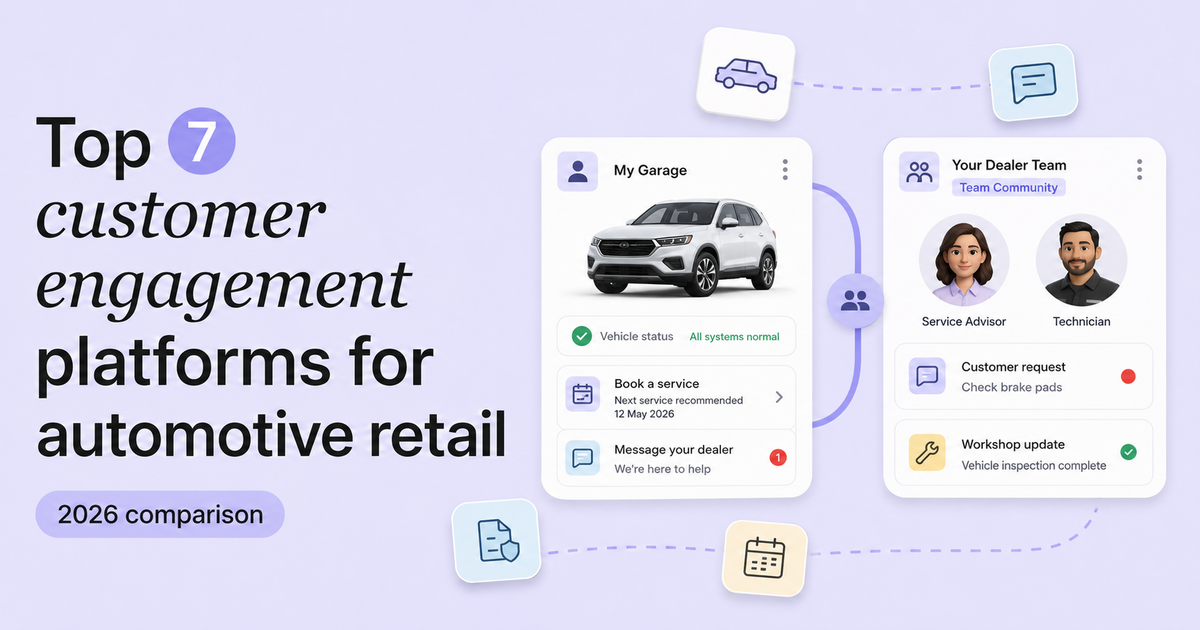
Top 7 customer engagement platforms for automotive retail in 2026
7 minutes
|
Engage Solutions
A dealer group's hardest commercial problem is not selling the car. It is the three years afterwards. The customer drives off, the relationship moves to a service reminder and an MOT text, and by the time they are ready to change the vehicle they are back on Auto Trader comparing your group against everyone else's. The margin that was supposed to come from aftersales and repurchase leaks out quietly across those three years, one unanswered reminder at a time.
Most software sold to fix this was built for the dealership, not the driver. Dealer management systems run the business brilliantly and treat the customer as a record. Review tools chase a rating after the visit. Video platforms make the workshop more persuasive during the visit. Very little is built to hold a relationship with the driver when no transaction is running.
This page compares seven platforms dealer groups use to engage customers: what each one does well, where each one stops, and which type of group it suits. It also pins down what the category actually means, so you can hold a demo against a definition. One of the seven is ours, and you should read that section knowing it. Everything about the other six comes from their own published material.
The seven platforms at a glance
| Platform | Best fit | Strong features | Weak points | Drivers + staff |
|---|---|---|---|---|
| Engage | UK and Ireland dealer groups with multiple sites and brands that want to own the driver relationship between purchases. |
|
|
Yes, one platform |
| Keyloop | Groups wanting one retail platform spanning enquiry, sale, ownership and retention. |
|
|
Dealer systems first |
| CitNOW Group | Groups where personalised video in sales and workshop is the retention lever. |
|
|
Customers only |
| Cox Automotive Xtime | Groups whose priority is service retention and workshop utilisation. |
|
|
Customers only |
| Podium | Single sites and smaller groups wanting faster lead response and more reviews. |
|
|
Customers only |
| Salesforce Automotive Cloud | Large groups and OEMs with the internal capacity to run an enterprise CRM programme. |
|
|
Configurable, build it yourself |
| Pinewood Technologies | UK groups wanting a modern cloud DMS with customer comms attached. |
|
|
Dealer systems first |
What is an automotive customer engagement platform?
An automotive customer engagement platform is a branded digital space, normally a mobile app with a web version alongside it, where a dealer group communicates with drivers continuously rather than only when a transaction is due. It combines the transactional layer that already exists (service booking, MOT and reminder scheduling, video updates, approvals and payment) with content, community and offers, and it measures engagement so the group can act on who has gone quiet.
The distinction that matters is between a reminder and a relationship. Most dealer software is very good at the reminder. It knows the vehicle, the mileage and the service interval, and it fires a message at the right moment. That is worth real money and no group should give it up. It is also the entire extent of the relationship for most drivers, which is why a group's share of a customer's ownership years is usually much smaller than it looks.
Three levels are worth separating, because vendors at all three use the same words.
Level one is transactional messaging. Service due, MOT due, here is your video, approve this work, pay here. Necessary, and driven entirely by the service calendar.
Level two is a customer portal. The driver logs in, sees their vehicle, their history and their documents, books a slot. Better, and still tied to the vehicle record and the next job.
Level three is engagement. The group holds an audience it owns: drivers who open the app because there is something there for them between services. Model-specific guidance, EV charging and range content for a first-time electric driver, track days and owners' club events, early access to a plate-change offer, a route to ask a question without ringing the branch. Every interaction builds first-party data the group has consent to use, which matters more each year as acquisition costs rise and third-party tracking degrades.
There is a fourth point that automotive retail, more than most sectors, cannot separate out. The experience a driver gets is delivered by colleagues across multiple sites: service advisors, technicians, sales executives, often on shift, rarely at a desk, frequently new. When a service advisor cannot find the current manufacturer bulletin or the group's own policy, the customer waits. When a new starter takes six weeks to become useful, the customer feels it as a slower, less certain answer. So the engagement layer that reaches drivers and the one that reaches the workshop floor are describing the same service from two ends.
Good, then, looks like this: one branded platform, both audiences, live in weeks, measured continuously. That is the bar this article uses.
How we evaluated these platforms
Seven criteria, chosen because they separate the products rather than flatter any one of them.
- Both audiences in one platform. Can the group run driver engagement and colleague engagement from the same product, with the same identity model and the same analytics?
- Mobile reach without training. Drivers will not learn software to service a car, and a technician between jobs will not either. Does it feel like an app people already use?
- Life between transactions. Does the product give the driver a reason to open it when nothing is due?
- AI that acts rather than answers. A chat window is not the same as something that completes a booking, a rebook or a document request end to end.
- Independence from your DMS. Does it work whatever you run behind it, or does it require a particular dealer management system to exist at all?
- Multi-site and multi-brand reality. Can it handle franchise boundaries, brand identity and site-level permissions without a separate build per location?
- Services that make adoption land. Software alone has a poor record here. Does the vendor bring a framework and people, or a licence and a login?
1. Engage
Engage is an AI-powered community engagement platform built for mid-market and enterprise organisations, roughly 250 to 10,000+ people, and strongest in the UK and Ireland. For a dealer group it does something none of the other platforms here attempt: it runs the group's drivers and the group's colleagues from one branded app.
Why one platform for both audiences matters in a dealer group
A multi-site group is really two engagement problems that everyone buys separately. The driver wants to know what is happening with their car, wants their documents in one place, and wants an answer to a question that does not need a service advisor to pick up the phone. The service advisor wants the current bulletin, the group's own process, and a new starter who is useful in week two rather than week seven. Those look like two purchases. They are two ends of the same service.
When they run on one platform, three things change. The group sees one picture of engagement across both sides. The customer team stops guessing which drivers have gone quiet, because quiet becomes a measurable state rather than a feeling. And the group stops paying for, integrating and separately administering two products that duplicate most of their own plumbing.
Engage already runs across automotive retail at scale. TrustFord went live in three weeks and reached 100% adoption, and PartsPlus runs an enterprise deployment across its network. Both of those are colleague-side rollouts, so read them as evidence about reach and speed across a distributed, largely deskless workforce rather than as customer-retention results. Bravo Networks is also an Engage customer in the sector.
On the customer side, the strongest published proof Engage holds is from a different sector. AfterAthena, the employment law division of Napthens, built a branded client community with case management and CRM integrated behind it and holds 96% client retention and 96% client adoption. That is a law firm, not a dealer group, and it is included here because the mechanism transfers even though the sector does not: a branded community, integrated to the systems of record, that people open when nothing is due.
Appi AI, and what it actually does
Appi is the AI layer underneath the platform, organised into five capability pillars: Communications, Search & Knowledge, Agentic, Admin, and Analytics. It learns from behaviour, relationships and community networks rather than clicks alone, which in practice means it understands who talks to whom and what a given driver or team responds to.
The pillar that separates it from a website chatbot is Agentic. A chatbot retrieves an answer and hands the work back to a person. An agentic layer completes the request: a driver rebooking a missed service, asking for a copy of a service invoice, or chasing an approval, and a technician raising an internal request, all handled without a branch phone call. Search & Knowledge sits behind both audiences, so "where is that?" stops depending on who happens to be on shift. You can read more on how Appi AI works across the platform.

Speed, and why it is the real differentiator
Engage pairs the software with engagement frameworks and professional services, which is the reason most customers are live in weeks. TrustFord's three weeks is the number worth holding up against a dealer platform migration, where months of configuration are normal and adoption is a separate project that starts after go-live. For a group running a plate-change or a brand launch to a deadline, that gap is the whole decision.
Security is built for enterprise requirements: ISO 27001, GDPR alignment, SSO, role-based permissions and audit trails, with customer data segregated by site and by permission, which matters when franchise boundaries and brand agreements govern who may see what. See the automotive sector overview and the wider customer lifecycle capability for detail.
Where Engage is the wrong answer
Three honest limitations, and the first is the one that matters most in this sector.
Engage is not a dealer management system. It does not run your stock, your invoicing, your workshop loading or your manufacturer reporting, and it is not trying to. It sits alongside Keyloop, Pinewood, CDK or whatever you run and integrates with it. If what you actually need is to replace an ageing DMS, this is the wrong list and Keyloop and Pinewood are the right one.
The category is new. Community Engagement Platform is a term Engage is actively creating, and buyers do not search for it yet. If your procurement requires three vendors from an established analyst category, Engage is harder to slot in than a platform that has sat in a comparison grid for a decade.
The company is centred on the UK and Ireland. If your group's footprint is mostly North America or Asia-Pacific, other platforms here have deeper local presence and support hours in your time zones. There is also no free self-serve tier, because rollout is guided and the frameworks and services are part of what you buy.
Best for: UK and Ireland dealer groups with multiple sites and brands that want to own the driver relationship between purchases, and reach a deskless workforce properly at the same time.
Not sure where your group sits?
The free digital maturity assessment scores how your group currently communicates with drivers and colleagues, and shows what moving up a level would take. It runs in a few minutes and gives you something concrete to take into a board meeting.
2. Keyloop
Keyloop is the platform most UK groups already know, headquartered in Reading and formerly CDK Global International. Its Fusion Automotive Retail Platform is explicitly built to connect processes across the customer lifecycle from enquiry through ownership and retention, and it has been adding to that quickly: a Sales Hub for lead conversion that brings customer, vehicle and transaction data into a single workflow, piloted in UK dealerships before a wider rollout through the second half of 2026, and Kara AI for dealer support.
If your problem is that enquiry, sale and aftersales live in disconnected systems, Keyloop is aimed exactly at that, and its OEM relationships mean it is often the path of least resistance for a franchised group.
Trade-offs. The architecture is organised around dealer workflow, so the driver appears as a record inside the group's process rather than as a member of a community the group owns. Adopting it properly means an enterprise implementation and a long commitment, and in most cases you are buying the dealer management platform rather than an engagement layer you could put on top of what you already run. There is no colleague engagement side in the sense used here.
Best for: franchised groups consolidating onto one retail platform across enquiry, sale and retention.
3. CitNOW Group
CitNOW Group built its reputation on personalised video, and in UK automotive it is close to a standard: the sales walkaround and the technician's workshop video that turns a declined job into an approved one. The group has since broadened, launching Auto360, a CRM built on Salesforce's automotive platform that gives a single view of customer and vehicle data across marketing, sales and aftersales, and DataHub AI, which lets dealer staff query their data in plain English and get forecasts and recommended actions. It has also extended its long-running partnership with Keyloop, joining Keyloop's international partner network.
Video remains its strongest card, and for good reason: it is the single most effective tool most groups have for converting workshop work and building trust at the moment of the visit.
Trade-offs. Video is episodic by nature. It is excellent during a visit and silent between visits, which leaves the same gap this article is about. Auto360 is new and built on Salesforce's automotive platform, so adopting it means buying into that stack and its implementation profile. And the products are designed as dealer tools that reach the customer, rather than as a consumer-facing space the customer belongs to. There is no colleague engagement layer.
Best for: groups where video-led sales and aftersales conversion is the priority, particularly alongside Keyloop.
4. Cox Automotive Xtime
Xtime, part of Cox Automotive, is built around one job and does it thoroughly: service retention. Online scheduling that respects real workshop capacity, reminder and recall campaigns, declined-work follow-up, check-in and status updates, and reporting that tells a group where service revenue is leaking. For a group whose aftersales utilisation is the number the board watches, it is a serious tool.
Trade-offs. Its scope is the service cycle, so like the reminder layer described above it goes quiet once the job is closed and stays quiet until the next interval. Its centre of gravity is North America, which shapes both the product assumptions and the support model for a UK group. And there is no colleague engagement layer, so it solves the customer half of the picture only.
Best for: groups whose single priority is service retention and workshop utilisation.
5. Podium
Podium approaches the problem from the messaging end: unified SMS, web chat and social messaging in one inbox, AI responders that answer and qualify leads quickly, review generation, and payments. Its pitch is speed of response, and the underlying observation is a fair one, that most enquiries are lost to slowness rather than to price.
It is quick to switch on, which is a genuine advantage against every enterprise platform on this list.
Trade-offs. Messaging and reviews are not the same as an owned community: the relationship still lives in the customer's SMS app and in third-party review sites rather than in a space the group controls. The product is US-centred and built for single sites and smaller groups, so multi-brand, multi-site franchise structures are not its natural shape. And there is no colleague engagement layer.
Best for: single sites and smaller groups wanting faster lead response and a stronger review profile.
6. Salesforce Automotive Cloud, now Agentforce Automotive
Salesforce Automotive Cloud, which Salesforce rebranded to Agentforce Automotive during its 2026 move away from "Cloud" naming, brings a driver, household and vehicle data model to the standard Salesforce platform, with the automation, analytics and ecosystem that come with it. It is the most configurable option here by a distance, and it is increasingly the foundation other automotive products are built on, CitNOW's Auto360 among them.
For a large group or an OEM that wants one customer data model across markets and the ability to build whatever journey it likes on top, this is the natural choice.
Trade-offs. It is a platform to build on rather than a branded consumer app you can launch. Getting to a driver-facing experience means design, build and usually an implementation partner, with timelines measured in quarters and cost to match. The engagement layer you end up with is exactly as good as what you build, which is a real risk for a group without internal product capability.
Best for: large groups and OEMs with the internal capacity and budget to run an enterprise CRM programme.
7. Pinewood Technologies
Pinewood Technologies is the UK cloud DMS challenger, now a standalone listed business after separating from Pendragon, and it has been winning international OEM agreements on the strength of a genuinely modern, cloud-native architecture. Its dealer management covers the operational ground well and includes integrated customer communications and portals.
For a UK group weighing a DMS move, it is a credible modern alternative to the incumbents and typically a lighter implementation than the largest platforms.
Trade-offs. Its customer engagement is DMS-adjacent: portals and communications that serve the operational process, rather than a community product with content, events and a reason to visit between jobs. Using it means running Pinewood as your dealer management system, which is a much larger decision than choosing an engagement layer. And its partner ecosystem, while growing, is smaller than the largest incumbents'.
Best for: UK groups modernising their DMS who want customer communications included in that move.
How to choose
Match the platform to the shape of the problem, not to the length of the feature list.
Your group runs multiple sites and brands in the UK or Ireland, and the commercial problem is the years between purchases. You want drivers engaged when nothing is due, an audience you own rather than rent from Auto Trader and Google, and your own deskless colleagues reachable on the same platform. That is Engage, and it is also the right answer if rising acquisition costs are pushing you towards consented first-party data, which is the conversation most customer experience leaders in automotive retail are now having.
Your enquiry, sale and aftersales systems do not talk to each other. Keyloop, and treat it as a platform decision rather than an engagement one.
Your conversion problem is at the moment of the visit. CitNOW. Nothing else on this list moves declined workshop work like video does.
Your board is watching service retention and workshop utilisation. Xtime, and accept that it will be quiet between service intervals.
You are a single site or a small group losing enquiries to slow response. Podium. It will be live in days and the others will not.
You are an OEM or a very large group that wants to build its own customer experience. Salesforce Automotive Cloud, and budget for the build as well as the licence.
You are replacing an ageing DMS. Pinewood or Keyloop, and revisit the engagement question once that is done.
You are not sure which of these problems you actually have. Start with the free digital maturity assessment. It will tell you whether your gap is transactional coverage, retention, or internal capacity, which decides the category before it decides the vendor.
Two related comparisons, if your question is a different one: client engagement platforms for law firms covers the same customer-side argument in professional services, and the top employee engagement platforms for HR teams covers the colleague side on its own.
Frequently asked questions
What is an automotive customer engagement platform?
It is a branded digital space, usually a mobile app with a web version, where a dealer group communicates with drivers continuously rather than only when a service or a renewal is due. It combines the transactional layer (booking, reminders, video, approvals, payment) with content, community and offers, and it measures engagement so the group can see who has gone quiet. The distinction from a customer portal is that a portal exists to serve the next job, while an engagement platform holds the relationship between jobs.
Is this the same as a dealer management system?
No, and confusing the two is the most common mistake in this category. A DMS runs the business: stock, invoicing, workshop loading, manufacturer reporting. A customer engagement platform runs the relationship with the driver. Keyloop and Pinewood on this list are dealer management platforms with customer capability attached. Engage, Xtime and Podium sit alongside whatever DMS you run. If your real problem is an ageing DMS, solve that first.
How long does it take to get a driver app live?
It depends on which level you are buying. Messaging tools such as Podium can be switched on in days. A full branded platform covering drivers and colleagues is normally a matter of weeks: Engage customers are typically live in weeks, and TrustFord went live in three, which was a colleague rollout across a large distributed workforce. An enterprise CRM build on Salesforce Automotive Cloud, or a DMS migration, is planned in quarters.
Can one platform really serve both drivers and dealership staff?
Yes, and in a multi-site group there is a strong argument that it should. The driver's experience is produced by colleagues on the workshop floor and the sales drive, so the speed a service advisor can find a bulletin or a group policy turns directly into the speed a customer gets an answer. Running both audiences on one platform gives the group one view of engagement, one identity and permissions model, and one set of analytics. Permissions are what make it safe: customer-facing spaces and internal spaces are separated by role and by site, with audit trails on both.
How is Appi different from a chatbot on our dealership website?
A chatbot retrieves an answer and hands the task back to a person. Appi is an engagement layer across five capability areas, Communications, Search & Knowledge, Agentic, Admin and Analytics, and the Agentic pillar completes routine requests end to end rather than describing how to complete them: rebooking a missed service, retrieving an invoice, chasing an approval. It also learns from behaviour, relationships and community networks rather than clicks alone.
Why would a dealer group build a community rather than just send better reminders?
Because a reminder is only as valuable as the moment it lands in, and a group only gets a handful of those moments a year. A community gives drivers a reason to open the app when nothing is due, which turns an audience the group rents from Auto Trader and Google into one it owns, with consent and a record of what each driver cares about. When they are ready to change the vehicle, the group is already in the relationship rather than bidding for the search.
Will it work across multiple franchises and brands?
It has to, and this is worth testing hard in any demo. Ask how brand identity is handled per site, how franchise boundaries govern who can see and post what, whether a customer of two brands within your group has one identity or two, and what the manufacturer's compliance requirements do to your content. Engage's model separates spaces by role and by site, with audit trails, which is the shape multi-brand groups need.
Do we need to replace our existing customer systems?
Not for every option here. Engage, Xtime and Podium sit alongside your DMS and integrate with it. Keyloop and Pinewood are dealer management platforms, so their customer capability comes with running them. Salesforce Automotive Cloud can integrate or become the system of record depending on how far you take it. If replacing core systems is not on the table this year, that alone rules several options in or out.
See it running
The fastest way to judge whether one platform for drivers and colleagues fits your group is to see it against your own brands, sites and service data. Book a demo and we will walk through how a group like yours would set it up, what the first four weeks look like, and what we would measure at the end of them.
Related case studies
One-way messages fade. Two-way engagement sticks. Engage turns communication into connection through an AI-powered platform.
Engage confirms that it has been appointed by one of the UK’s leading automotive Parts suppliers
Engage is appointed by PartsPlus
1 min
Engaged in Conversation with…Sharon Ashcroft, TrustFord
Sharon is actually the HR director for TrustFord (the world’s largest dealer-owned motor group) is a regular in the Sunday Times Top 25 Best Companies to Work For list