
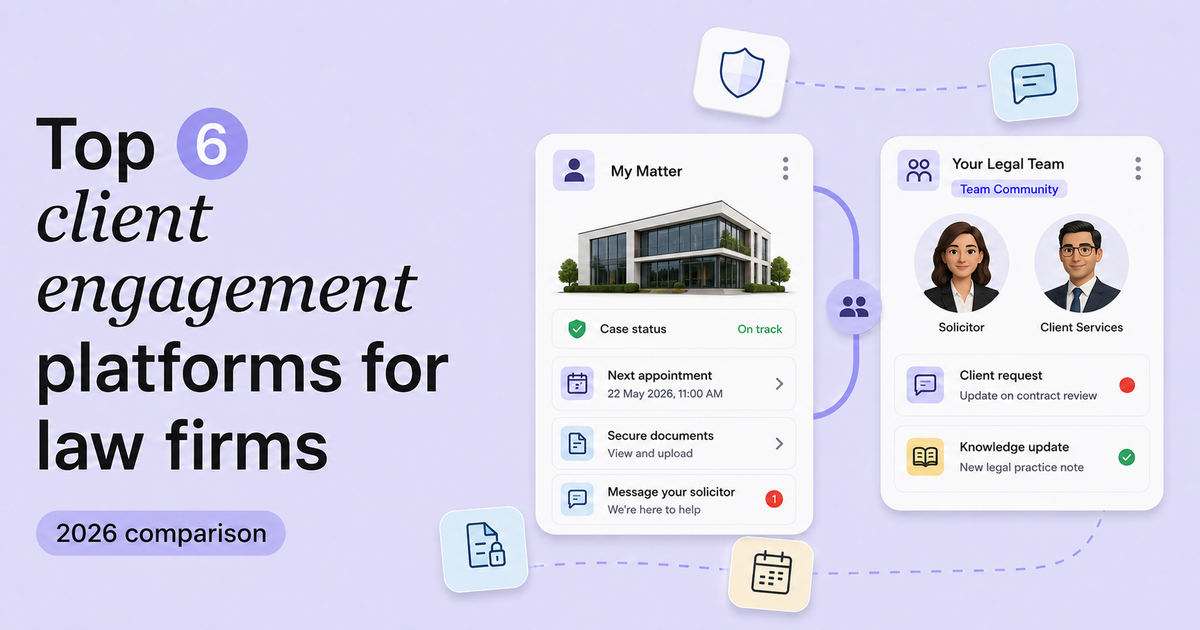
Top 6 client engagement platforms for law firms in 2026
7 minutes
|
Engage Solutions
Most law firms lose clients quietly. Not through a complaint, and not through a bad result, but through the months of silence between matters, when the firm has nothing scheduled to say and the client has no particular reason to think about them. The matter closes, the file is archived, and a relationship that took months to build goes cold. Two years later that client searches for a solicitor as if the firm never existed.
The tools sold to fix this started as secure document exchange, grew into case-progress portals, and are now marketed as client engagement platforms. The label has stretched a good deal further than most of the products have. A portal that tells a client their matter moved from stage three to stage four is useful, and it is not the same thing as a relationship.
This page compares six client engagement platforms used by law firms: what each one does well, where each one stops, and which type of firm it actually suits. It also pins the category down to a definition you can hold a demo against. One of the six is ours, and you should read that section knowing it. Everything about the other five comes from their own published material.
The six platforms at a glance
| Platform | Best fit | Strong features | Weak points | Colleagues + clients |
|---|---|---|---|---|
| Engage | Mid-market and enterprise firms in the UK and Ireland with a client base to retain and grow. |
|
|
Yes, one platform |
| Case Status | US firms with high matter volume and repeatable case types, particularly personal injury. |
|
|
Clients only |
| Thomson Reuters HighQ | Large firms with corporate clients and the capacity to run an enterprise implementation. |
|
|
Partly, matter-scoped |
| Clio | Small and mid firms wanting one system for practice management, billing and client comms. |
|
|
Clients only |
| LEAP / LawConnect | UK small to mid firms already running LEAP as their practice management system. |
|
|
Clients only |
| Higher Logic | Firms running a membership-style client body who want a web community. |
|
|
Clients or members only |
What is a client engagement platform, really?
A client engagement platform for law firms is a branded digital space, normally a mobile app with a web version alongside it, where a firm communicates with its clients continuously rather than only while a matter is live. It combines matter transparency (status, documents, e-signature, payments) with content and community (updates, guidance, events, direct access to the team), and it measures engagement so the firm can act on what it sees.
That is the working definition. It is worth breaking into the three levels most firms move through, because vendors at all three levels use the same words.
Level one is secure exchange. A place to send documents that is not email. It solves a compliance problem and nothing else. Most firms passed this point years ago.
Level two is matter transparency. The client logs in and sees where things stand, uploads what was asked for, signs, and pays. This is what almost everyone means by a law firm client portal, and it is genuinely valuable: it cuts the "any update?" calls that eat a fee earner's afternoon. Its limit is built into its shape. The portal exists because the matter exists. When the matter ends, so does the reason to open it.
Level three is engagement. The relationship carries on when no matter is running. The firm publishes guidance its clients want, runs events, answers routine questions without a fee earner touching them, and holds an audience it owns rather than one it rents from Google and LinkedIn. Every interaction builds first-party data the firm has consent to use, which matters more each year as acquisition costs climb and third-party tracking degrades.
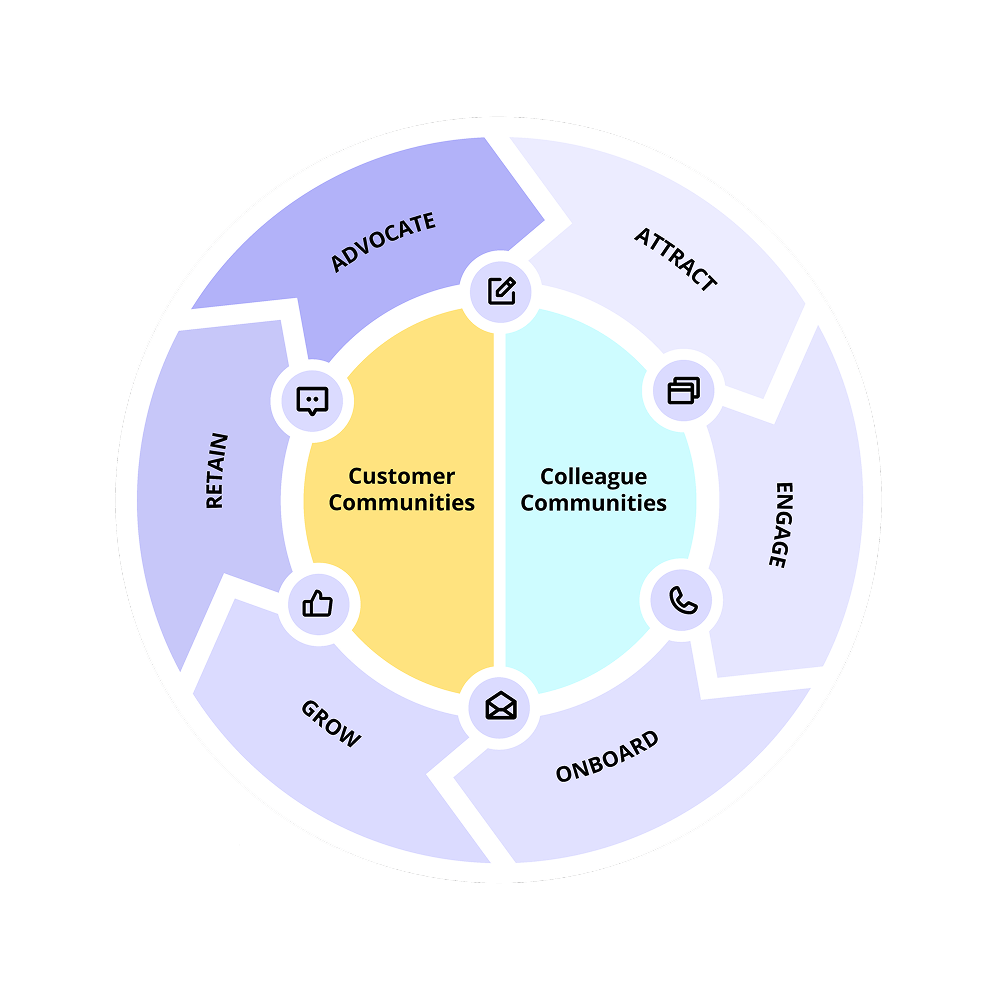
There is a fourth point that the legal sector, more than most, cannot separate out. The service a client experiences is delivered by colleagues. When a solicitor cannot find the current version of a policy, the client waits. When a new starter takes six weeks to get productive, the client feels it as a slower response. So the engagement layer that reaches clients and the one that reaches the firm's own people are describing the same relationship from two ends. Running them as two disconnected systems is a choice, and it is usually an expensive one.
Good, then, looks like this: one branded platform, both audiences, live in weeks, measured continuously. That is the bar this article uses.
How we evaluated these platforms
Seven criteria, chosen because they separate the products rather than flatter any one of them.
- Both audiences in one platform. Can the firm run client engagement and colleague engagement from the same product, with the same identity model and the same analytics?
- Mobile reach without training. Clients will not learn software to work with their solicitor. Neither will a fee earner between hearings. Does it feel like an app people already use?
- AI that acts rather than answers. A search box with a chat window is not the same as something that completes a routine request end to end.
- Time to live. Weeks or quarters. This is the single biggest predictor of whether a rollout ever reaches real adoption.
- Independence from your practice management system. Does the platform work whatever you run behind it, or does it require a particular case management system to exist at all?
- Enterprise security and UK compliance. ISO 27001, GDPR, SSO, role-based permissions, audit trails. Non-negotiable in legal.
- Services that make adoption land. Software alone has a poor record here. Does the vendor bring a framework and people, or a licence and a login?
1. Engage
Engage is an AI-powered community engagement platform built for mid-market and enterprise organisations, roughly 250 to 10,000+ people, and strongest in the UK and Ireland. For a law firm it does something none of the other platforms here attempt: it runs the firm's clients and the firm's colleagues from one branded app.
Why one platform for both audiences matters in a law firm
Take a personal injury or employment practice. The client wants to know what is happening, wants documents in one place, and wants an answer to a question that a fee earner does not need to be involved in. The fee earner wants the current policy, the right precedent, and a new starter who is useful in week two rather than week seven. Those look like two different software purchases. They are two ends of the same service.
When they run on one platform, a few things change. The firm sees one picture of engagement across both sides. The client-facing team stops guessing which clients have gone quiet, because quiet is now a measurable state rather than a feeling. And the firm stops paying for, integrating and separately administering two products that duplicate most of their own plumbing.
Engage's own legal deployments run both ways. AfterAthena, the employment law division of Napthens, built a branded client community with case management and CRM integrated behind it, so clients reach documents, updates and their legal team in one place. That community holds 96% client retention and 96% client adoption. CFG Law and Frenkel Topping Group are also Engage customers in the legal and financial advisory space. At Frenkel Topping, 75% of colleagues are actively engaged on the platform, which is a colleague-side result rather than a client-side one, and worth reading as evidence about adoption rather than about client retention.
Appi AI, and what it actually does
Appi is the AI layer underneath the platform, organised into five capability pillars: Communications, Search & Knowledge, Agentic, Admin, and Analytics. It learns from behaviour, relationships and community networks rather than clicks alone, which in practice means it understands who talks to whom and what a given client or team responds to.
The pillar that separates it from a website chatbot is Agentic. A chatbot retrieves an answer and hands the work back to a person. An agentic layer completes the request: a client asking for a copy of a signed document, a colleague raising an internal request, a routine status query that would otherwise land in a fee earner's inbox. Search & Knowledge sits behind both audiences, so the question "where is that?" stops depending on who happens to be at their desk. You can read more on how Appi AI works across the platform.

Speed, and why it is the real differentiator
Engage pairs the software with engagement frameworks and professional services, which is the reason most customers are live in weeks. TrustFord went live in three weeks and reached 100% adoption, a colleague-side rollout across a large distributed workforce. For a law firm the comparison worth making is against an enterprise portal programme, where months of configuration are normal and adoption is a separate project that starts after go-live.
Security is built for enterprise legal requirements: ISO 27001, GDPR alignment, SSO, role-based permissions and audit trails, with client data segregated by matter and by permission. See the law firm client portal capability and the wider legal sector overview for detail.
Where Engage is the wrong answer
Three honest limitations.
The category is new. Community Engagement Platform is a term Engage is actively creating, and buyers do not search for it yet. If your procurement process requires three vendors in an established analyst category, Engage will be harder to slot in than a platform that has been sitting in a comparison grid for a decade.
The company is centred on the UK and Ireland. If your firm's client base is mostly US or Asia-Pacific, other platforms on this list have deeper local presence and support hours in your time zones.
There is no free self-serve tier. Rollout is guided, and the frameworks and services are part of what you buy. That is deliberate, because unguided rollouts of this kind of platform have a poor adoption record, and it does mean you cannot try it in an afternoon on a credit card.
Best for: mid-market and enterprise firms in the UK and Ireland that want to keep clients between matters, build an owned and consented audience against rising acquisition costs, and reach their own colleagues properly at the same time.
2. Case Status
Case Status is the closest thing on this list to a pure-play legal client engagement product, and it uses that exact language. It sits on top of your case management system and turns the data already in there into client communication: real-time matter updates, checklists of what the client still owes you, video messaging, satisfaction feedback, and an AI layer the company calls Client Intelligence.
It is a serious product with money behind it, having raised a $19.7m Series B in October 2024 and $33.6m in total. The design assumption running through it is high volume: a firm handling hundreds or thousands of similar consumer matters, where the cost of "any update?" calls is enormous and automating status is worth real money. For that firm, Case Status is very well aimed.
Trade-offs. It is a client-side product, with no colleague engagement layer, so it solves one half of the picture described above. It depends on integrating with your case management system, which means your coverage is bounded by what that integration exposes. And it is US-centred, with a customer base built largely around US personal injury and consumer practices, and no evident UK footprint or UK-specific compliance positioning.
Best for: US firms with high matter volume and repeatable case types, particularly personal injury.
3. Thomson Reuters HighQ
HighQ is the enterprise option, and for large firms serving corporate clients it is often already in the building. It combines secure client portals with collaboration, matter management, workflow automation and document sharing, and it scales to the kind of complex, multi-party, long-running work where a deal room and an audit trail are the point. Recent releases have added customisable forms for different work types and dashboards that can be targeted at different client personas.
Where HighQ is strong is depth on the matter itself. If your client is a general counsel running fifteen concurrent matters with your firm and wants one place to see all of them, with document workflows and reporting attached, this is built for that.
Trade-offs. The architecture is organised around matters and documents rather than around a continuing relationship, so it answers "what is happening on this deal?" better than "why should this client still feel connected to us in eighteen months?". Implementation is an enterprise programme measured in months, not weeks, and configuration is a real workstream. It is desktop-first in feel, which suits a general counsel and suits a consumer client much less. Licensing is priced for large firms.
Best for: large firms with corporate clients, complex matters, and the internal capacity to run an enterprise implementation.
4. Clio
Clio is the biggest name in legal practice management, used by more than 200,000 legal professionals, and its client-facing layer, Clio for Clients, comes as part of the package. Clients get a portal and mobile app for secure messaging, document sharing, e-signature and payment, so the firm stops running its client relationship through email attachments.
Clio has also become considerably larger in the last year. It completed a $1bn acquisition of legal intelligence provider vLex in November 2025 and raised a $500m Series G at a $5bn valuation at the same time, putting substantial AI and legal research capability behind the practice management product.
Trade-offs. The portal is a feature of the practice management system, which means two things: you need to run Clio to have it, and the client's reason to be there is tied to a live matter. Clio's own documentation makes the second point plainly, since portals are created one per matter. There is no colleague engagement layer, and no community layer for clients between matters. Clio's centre of gravity remains North America and smaller firms, though its UK presence is real and growing.
Best for: small and mid firms that want one system for practice management, billing and client communication, and are happy for the client relationship to be matter-shaped.
5. LEAP and LawConnect
For UK small and mid firms, LEAP is often the incumbent, and its client-facing app LawConnect is included free for firms using the platform. Clients get documents, online payments, appointment booking and electronic signature through dedicated mobile apps and a web version, with a layout designed so clients can see and action what is outstanding without being chased. LEAP has since added LEAP Leads, which pulls new enquiries into the same environment and onboards them into the firm.
For a firm already running LEAP this is close to free capability, and the integration is genuinely tight because it is the same vendor on both sides.
Trade-offs. It requires LEAP. If your firm runs something else, LawConnect is not a route you can take without changing your practice management system, which is a much larger decision. The engagement model is transactional, built around documents, payments and appointments rather than continuing content or community. There is no colleague engagement layer. And the product is aimed at solo, small and lower mid-market firms, so larger firms tend to outgrow the model.
Best for: UK firms already on LEAP that want a solid client portal without a separate purchase.
6. Higher Logic
Higher Logic Thrive is the outlier on this list, and it is here deliberately. It is a customer and member community platform rather than legal software: discussion spaces, member directories, resource libraries, events, learning and email marketing, built mainly for associations and membership bodies. Several professional bodies in the legal sector run on this kind of platform.
It earns its place because it is the only product here whose centre of gravity is the ongoing relationship rather than the transaction. If your firm runs something that behaves like a membership, an employment law retainer club, a subscription advisory service, a network of in-house counsel you convene, Higher Logic is designed for exactly that shape.
Trade-offs. It has no legal-specific workflow at all, so matter status, document exchange against a case, and case management integration are things you would build or connect yourself. It has no colleague engagement side. Pricing is custom and skews enterprise, with published estimates starting around $9,000 to $15,000 a year before implementation and configuration. And it is web-first in design, which is a meaningful gap if you need clients on their phones.
Best for: firms running a membership-style client body who want a web community and can live without matter-level integration.
How to choose
Match the platform to the shape of your client relationship, not to the length of the feature list.
Your firm is mid-market or enterprise, UK or Ireland based, and the commercial problem is retention and growth of an existing client base. You want clients engaged between matters, an audience you own rather than rent, and your own people reachable on the same platform. That is Engage. It is also the right answer if rising acquisition costs are pushing you towards consented first-party data, which is the conversation most customer success and client experience leaders in professional services are now having.
You are a US firm running high volumes of similar consumer matters. Case Status, without much hesitation. It is built for that economics and the UK options are not.
You are a large firm whose clients are general counsel running complex matters. HighQ. Buy it for the matter collaboration depth, and plan the implementation as a programme.
You are a smaller firm that wants one system to run everything. Clio, or LEAP if you are in the UK and want the client app included. Both are sound. Understand that you are buying a matter-shaped client relationship, and that the portal goes quiet when the matter closes.
You convene a membership rather than a caseload. Higher Logic, and budget for the integration work.
You are not sure which of these problems you actually have. Start with the free digital maturity assessment. It takes a few minutes and it will tell you whether your gap is transparency, retention, or internal capacity, which decides the category before it decides the vendor.
If your question is about your own people rather than your clients, the colleague-side equivalent of this article compares the platforms built for that job: the top employee engagement platforms for HR teams.
Frequently asked questions
What is a client engagement platform for law firms?
It is a branded digital space, usually a mobile app with a web version, where a firm communicates with clients continuously rather than only while a matter is live. It combines matter transparency (status, documents, e-signature, payments) with content and community, and it measures engagement so the firm can act on it. The distinction from a client portal is that a portal exists because a matter exists, while an engagement platform holds the relationship between matters as well.
Is a client portal the same as a client engagement platform?
No. A client portal gives a client visibility of a live matter and a secure route to exchange documents. A client engagement platform includes that and adds the relationship layer: content the client wants, direct access to the team, events, and analytics on who is engaged and who has gone quiet. Most products sold as engagement platforms are portals with a communication feature attached, which is worth testing directly in any demo.
How long does it take to get a client engagement platform live?
It depends on which level you are buying. A portal attached to your existing practice management system can be switched on in days, because it is a feature of software you already run. A full branded platform covering clients and colleagues is normally a matter of weeks: Engage customers are typically live in weeks, and TrustFord went live in three. An enterprise collaboration implementation such as HighQ is usually planned in months.
Can one platform really serve both clients and colleagues?
Yes, and in a law firm there is a strong argument that it should. The client's experience is produced by colleagues, so the speed a fee earner can find a policy or a precedent turns directly into the speed a client gets an answer. Running both audiences on one platform gives the firm one view of engagement, one identity and permissions model, and one set of analytics. The permissions work is what makes it safe: client-facing spaces and internal spaces are separated by role, with audit trails on both.
How is Appi different from a chatbot on our website?
A chatbot retrieves an answer and hands the task back to a person. Appi is an engagement layer across five capability areas, Communications, Search & Knowledge, Agentic, Admin and Analytics, and the Agentic pillar completes routine requests end to end rather than describing how to complete them. It also learns from behaviour, relationships and community networks rather than clicks alone, so it works from how people in the firm and the client base actually interact, not from page views.
Why would a law firm build a client community before someone becomes a client?
Because the alternative is renting that audience every time. Paid acquisition costs rise every year, third-party tracking keeps degrading, and a firm that only holds contact details for current matter clients has to buy attention again for every campaign. A community that people can join before instructing you gives the firm a consented first-party audience it owns, with a record of what each person cares about. When a legal need arises, the firm is already in the relationship rather than bidding for the search.
What about client confidentiality and data protection?
Any platform holding client matter data needs ISO 27001 certification, GDPR alignment, SSO, role-based permissions and audit trails as a baseline, with data segregated so a client sees only their own matters. Ask any vendor where data is hosted, how permissions are inherited when a matter team changes, and what the audit trail captures. Engage's platform is built to these requirements, and the same questions are worth putting to every vendor on this list.
Do we need to replace our case management system?
Not for every option here. Engage and Case Status sit alongside your case management system and integrate with it. Clio and LEAP are practice management systems, so their client portals require you to run them. HighQ can integrate or extend depending on your setup, and Higher Logic has no legal-specific integration to begin with. If replacing your case management system is not on the table this year, that alone rules several options in or out.
See it running
The fastest way to judge whether one platform for clients and colleagues fits your firm is to see it with your own matter types and client base in front of you. Book a demo and we will walk through how a firm like yours would set it up, what the first four weeks look like, and what we would measure at the end of them.
Related case studies
One-way messages fade. Two-way engagement sticks. Engage turns communication into connection through an AI-powered platform.

North West based law firm Napthens launches community app with Engage
North West based law firm Napthens deployed Engage (After Athena Hub) for their After Athena business.
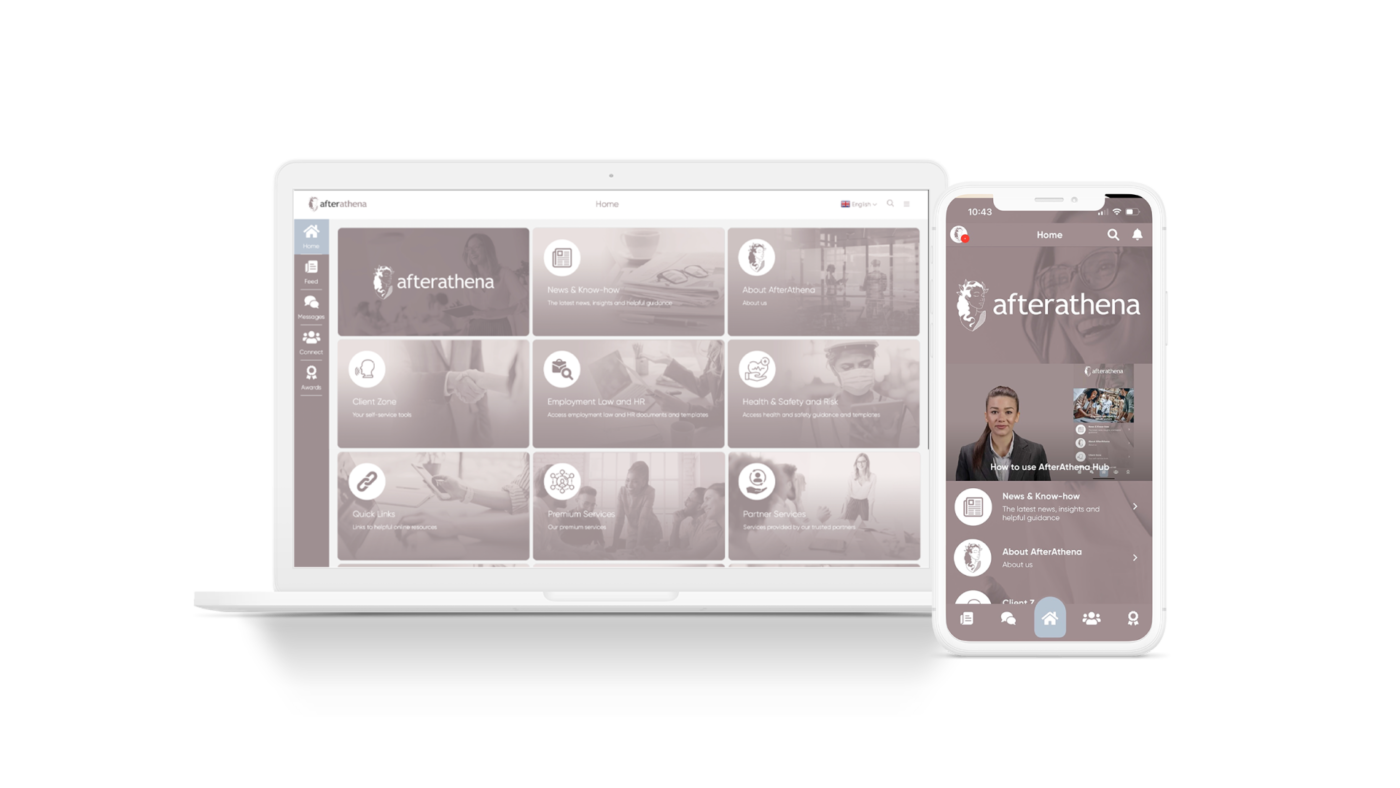
Leading law firm Napthens details how new bespoake app will raise the bar in client-facing technology
Napthens details how new bespoke app will raise the bar in client-facing technology

CFG Law Elevates Colleague Engagement and Client Service Excellence with ESG’s Platform
CFG Law Elevates Colleague Engagement and Client Service Excellence with ESG’s Platform