
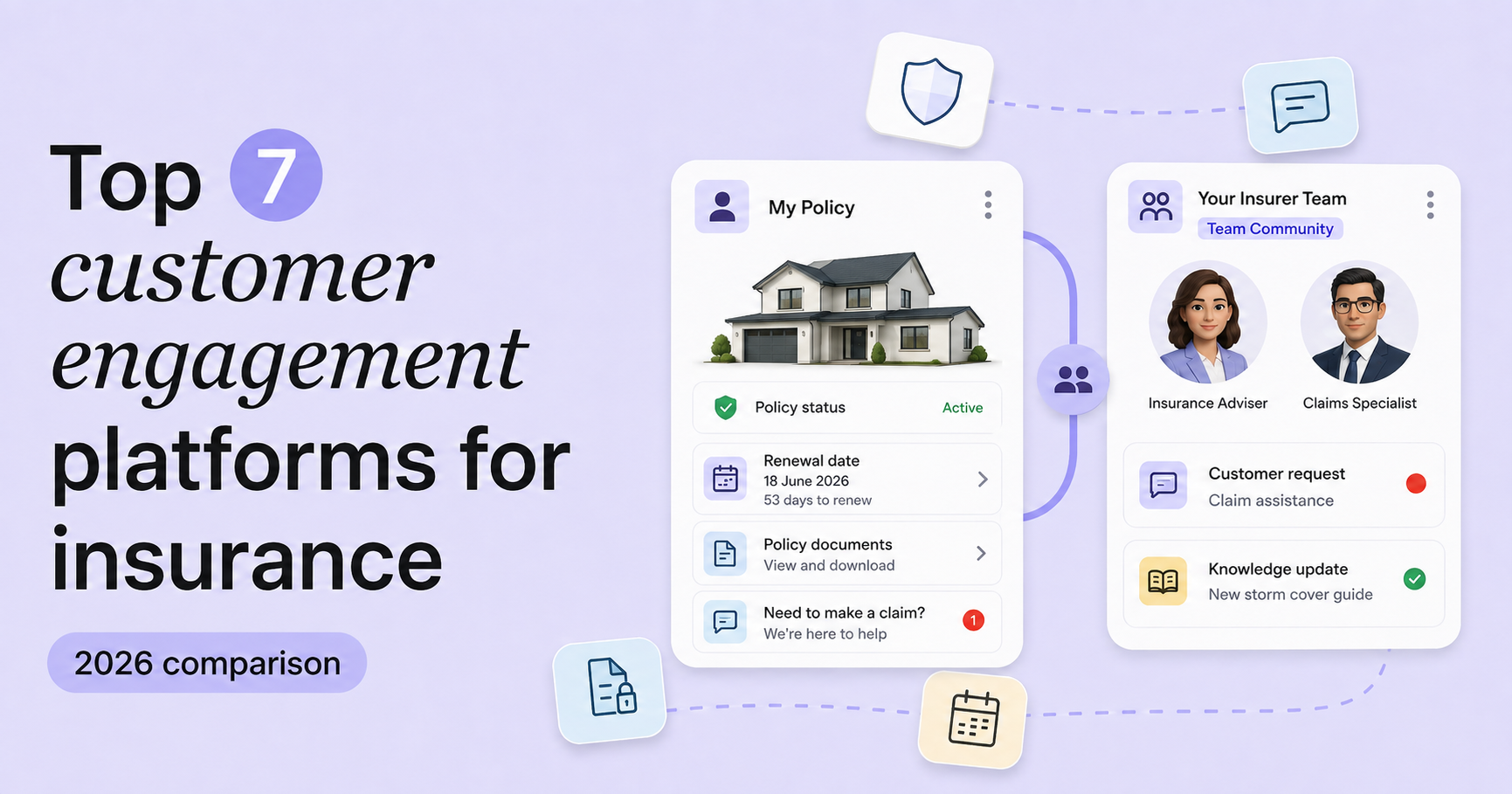
Top 7 customer engagement platforms for insurers and brokers in 2026
7 minutes
|
Engage Solutions
Insurance is the only relationship most people have that expires every twelve months and asks to be re-justified. A customer buys a policy, hears almost nothing for a year, then receives a renewal notice that arrives as a price and nothing else. At that moment the entire relationship is reduced to one number, and the customer compares that number against an aggregator in about ninety seconds. Everything the business did to win them is worth very little in that comparison.
The economics follow from that. Retention decides the book. Cross-sell is the cheapest growth available and almost nobody achieves it, because selling a second product requires a relationship that the year of silence has quietly dismantled. Acquisition costs keep rising to replace customers the business already had.
This page compares seven platforms insurers and brokers use to engage customers: what each one does well, where each one stops, and which type of business it suits. It also pins down what the category actually means, so you can hold a demo against a definition. One of the seven is ours, and you should read that section knowing it. Everything about the other six comes from their own published material.
The seven platforms at a glance
| Platform | Best fit | Strong features | Weak points | Customers + colleagues |
|---|---|---|---|---|
| Engage | UK and Ireland brokers, MGAs and insurance groups whose problem is renewal retention and cross-sell. |
|
|
Yes, one platform |
| Acturis | UK brokers and MGAs wanting the sector's default end-to-end platform. |
|
|
Broker systems first |
| Open GI | UK personal lines brokers and SME commercial specialists. |
|
|
Broker systems first |
| Applied Epic | Brokers operating on both sides of the Atlantic, commercial lines heavy. |
|
|
Broker systems first |
| Salesforce Financial Services Cloud | Large groups with the internal capacity to run an enterprise CRM programme. |
|
|
Configurable, build it yourself |
| Guidewire | Carriers replacing or modernising core policy, billing and claims. |
|
|
Policyholders only |
| Duck Creek | Carriers wanting SaaS core with faster product configuration. |
|
|
Policyholders only |
What is an insurance customer engagement platform?
An insurance customer engagement platform is a branded digital space, normally a mobile app with a web version alongside it, where an insurer or broker communicates with customers continuously rather than only at quote, claim and renewal. It combines the transactional layer that already exists (documents, policy changes, claims status, payments) with content, community and guidance, and it measures engagement so the business can see who has disengaged well before the renewal notice goes out.
The distinction that matters is between a notice and a relationship. Policy administration systems are extremely good at the notice. They know the policy, the expiry date and the premium, and they generate the right document at the right moment. That is essential and no business should give it up. It is also, for most customers, the entire relationship, which is why renewal so often comes down to price alone.
Three levels are worth separating, because vendors at all three use the same words.
Level one is document delivery. Schedules, certificates, renewal invitations. A compliance obligation met.
Level two is a customer portal. The policyholder logs in, sees cover and documents, makes a mid-term adjustment, tracks a claim. Genuinely useful, and driven by the policy lifecycle. It exists because the policy exists, so it goes quiet the moment nothing is happening.
Level three is engagement. The business holds an audience it owns: customers who open the app because something there is useful between renewals. Risk guidance a commercial client can act on, help for a first-time landlord or a young driver, claims prevention content ahead of a storm, community and events for a specialist book, a route to ask a question without a phone queue. Every interaction builds first-party data the business has consent to use, which matters more each year as acquisition costs climb and third-party tracking degrades.
This is where cross-sell actually comes from. A second product is not sold by a well-timed email to somebody who has not heard from you in eleven months. It is sold when the business knows what a customer cares about and has earned enough attention to make a relevant suggestion. That is a function of engagement, not of campaign timing.
There is a fourth point that insurance, more than most sectors, cannot separate out. The customer's experience is produced by colleagues, and in this sector they are frequently distributed across many sites and acquired businesses. When an adviser cannot find the current wording, the underwriting rule or the group's own process, the customer waits. When a new starter takes six weeks to become useful, the customer experiences it as a slower, less certain answer. So the engagement layer that reaches customers and the one that reaches advisers describe the same service from two ends.
Good, then, looks like this: one branded platform, both audiences, live in weeks, measured continuously. That is the bar this article uses.
How we evaluated these platforms
Seven criteria, chosen because they separate the products rather than flatter any one of them.
- Both audiences in one platform. Can the business run customer engagement and colleague engagement from the same product, with the same identity model and the same analytics?
- Life between renewals. Does the product give a policyholder any reason to open it in the eleven months when nothing is due?
- Mobile reach without training. Customers will not learn software to hold a policy. Does it feel like an app people already use?
- AI that acts rather than answers. A chat window is not the same as something that completes a document request, a mid-term adjustment or a claims update end to end.
- Independence from your policy administration system. Does it work whatever you run behind it, or does it require a particular platform to exist at all?
- Regulatory fit. Consumer Duty evidencing, clear records of what a customer was told and when, ISO 27001, GDPR, SSO and audit trails.
- Services that make adoption land. Software alone has a poor record here. Does the vendor bring a framework and people, or a licence and a login?
1. Engage
Engage is an AI-powered community engagement platform built for mid-market and enterprise organisations, roughly 250 to 10,000+ people, and strongest in the UK and Ireland. For an insurer or broker it does something none of the other platforms here attempt: it runs the business's customers and its colleagues from one branded app.
Why one platform for both audiences matters in insurance
An insurance business is two engagement problems that are almost always bought separately. The policyholder wants their documents in one place, a straight answer about what is covered, and a way to sort a mid-term change without a phone queue. The adviser wants the current wording, the underwriting rule, and a new starter who is useful in week two rather than week seven. Those look like two purchases. They are two ends of the same service, and in a sector where acquired businesses accumulate faster than systems get consolidated, running them separately is expensive twice over.
When they run on one platform, three things change. The business sees one picture of engagement across both sides. The retention team stops discovering disengagement at renewal, because quiet becomes a measurable state months earlier, while there is still time to act. And the business stops paying for, integrating and separately administering two products that duplicate most of their own plumbing.
What Engage can and cannot show you in insurance
This is worth stating plainly, because the honest version is more useful to you than the marketing version.
Engage already runs at serious scale inside UK insurance. The Ardonagh Group connects 11,000 colleagues across 250 locations on Engage with 90% monthly engagement, and Adrian Flux connects 1,900 colleagues. Bravo Networks is also an Engage customer in the sector. Those are real deployments in real insurance businesses, and they tell you the platform works at insurance scale, across acquired businesses and distributed sites, with adoption that holds.
They are also all colleague-side deployments. None of them is a policyholder community, and we are not going to present them as one. If your question is specifically "show me an insurer whose renewal retention improved because of your customer community", Engage does not yet have a published, named example, and any vendor who answers that question too smoothly is worth pressing harder.
The strongest published customer-side proof Engage holds comes from a different sector. AfterAthena, the employment law division of Napthens, built a branded client community with case management and CRM integrated behind it and holds 96% client retention and 96% client adoption. That is a professional services firm, not an insurer. It is included because the mechanism transfers even though the sector does not: a branded community, integrated to the systems of record, that customers open when nothing is due, in a business whose relationship also used to go quiet between transactions.
Appi AI, and what it actually does
Appi is the AI layer underneath the platform, organised into five capability pillars: Communications, Search & Knowledge, Agentic, Admin, and Analytics. It learns from behaviour, relationships and community networks rather than clicks alone, which in practice means it understands who talks to whom and what a given customer or team responds to.
The pillar that separates it from a website chatbot is Agentic. A chatbot retrieves an answer and hands the work back to a person. An agentic layer completes the request: a customer retrieving a certificate, making a simple mid-term change, or checking where a claim has got to, and an adviser raising an internal request, all without joining a phone queue. Search & Knowledge sits behind both audiences, so "what does the wording actually say?" stops depending on who is available. You can read more on how Appi AI works across the platform.

Speed, regulation and security
Engage pairs the software with engagement frameworks and professional services, which is the reason most customers are live in weeks rather than quarters. Security and governance are built for enterprise requirements: ISO 27001, GDPR alignment, SSO, role-based permissions and audit trails, with data segregated by business and by permission, which matters when a group holds several acquired brands under one roof.
Consumer Duty is worth raising here, because it cuts both ways. A platform that records what a customer was shown, when, and whether they engaged with it, gives you evidence you currently have to assemble by hand. It also means the content you publish is now part of your regulatory surface, so the governance and approval model is not optional. See the insurance sector overview and the customer lifecycle capability for detail.
Where Engage is the wrong answer
Three honest limitations, and the first matters most in this sector.
Engage is not a policy administration system. It does not rate, bind, issue, handle claims or produce your regulatory returns, and it is not trying to. It sits alongside Acturis, Open GI, Applied Epic or your carrier core and integrates with it. If what you actually need is to replace an ageing policy system, this is the wrong list.
The category is new. Community Engagement Platform is a term Engage is actively creating, and buyers do not search for it yet. If your procurement requires three vendors from an established analyst category, that is friction.
The company is centred on the UK and Ireland, so a business whose book is mostly outside those markets will find deeper local presence elsewhere. And there is no free self-serve tier, because rollout is guided and the frameworks and services are part of what you buy.
Best for: UK and Ireland brokers, MGAs and insurance groups that want to hold the customer relationship between renewals, build an owned and consented audience against rising acquisition costs, and reach a distributed colleague base at the same time.
Not sure where your business sits?
The free digital maturity assessment scores how your business currently communicates with customers and colleagues, and shows what moving up a level would take. It runs in a few minutes and gives you something concrete to take into a board meeting.
2. Acturis
Acturis is the technology provider of choice for brokers, insurers and MGAs throughout the UK, and for most UK broking businesses it is simply the system. It combines policy administration, accounts and billing in one integrated platform, handling client accounts, premium collection, broker commissions and IPT alongside the policy data, across both commercial and personal lines. Its insurer integrations and market reach are unmatched in the UK.
If your operational problem is running a broking business well, Acturis is the answer and this article is not arguing otherwise.
Trade-offs. The architecture is organised around the broker's process, so the customer appears as a record inside your workflow rather than as a member of a community you own. Customer contact is transactional by design: documents, notices, renewal invitations, the things the process requires. There is no community layer that gives a policyholder a reason to engage between renewals, and no colleague engagement side. Getting the customer capability means running Acturis, which for most UK brokers is already true and for everyone else is a large decision.
Best for: UK brokers and MGAs wanting the sector's default operational platform.
3. Open GI
Open GI is a long-established UK insurance software provider specialising in personal lines broker systems and SME commercial, with a strong footprint among thousands of UK broking firms, particularly those focused on personal lines distribution. It delivers end-to-end policy administration across quote-and-buy, mid-term adjustments, renewals, cancellations, documentation and audit history.
For a personal lines broker competing on distribution and speed to quote, its depth in that specific game is the reason it has lasted.
Trade-offs. It is policy administration rather than customer engagement, and the two are not the same purchase. Engagement is bounded by the policy lifecycle, which means it is present at quote, adjustment and renewal and absent in between, which is the gap this article is about. There is no colleague engagement layer.
Best for: UK personal lines brokers and SME commercial specialists.
4. Applied Epic
Applied Epic, from Applied Systems, is widely deployed across both US and UK markets for broker and agency operations. It is strong in commercial lines policy administration and notable for its dual-market footprint: brokers operating on both sides of the Atlantic often run Applied Epic in both jurisdictions, which removes a genuine operational headache for transatlantic businesses.
Trade-offs. It is agency management software, so its centre of gravity is the broker's internal operation rather than the customer's experience. Product priorities are weighted towards the larger US market, which shapes both the roadmap and the fit with UK regulatory expectations. Its customer-facing layer is a portal serving the policy, not a community, and there is no colleague engagement side.
Best for: commercial lines brokers operating across the UK and US.
5. Salesforce Financial Services Cloud
Salesforce Financial Services Cloud brings a household, policy and relationship data model to the standard Salesforce platform, with the automation, analytics and ecosystem that come with it. It is the most configurable option here by some distance, and for a large group that wants one customer data model across brands and territories, that flexibility is the attraction.
Trade-offs. It is a platform to build on rather than a branded customer app you can launch. Reaching a policyholder-facing experience means design, build and usually an implementation partner, with timelines in quarters and cost to match. The engagement layer you end up with is exactly as good as what you build, which is a real risk for a business without internal product capability. Colleague engagement is possible but is another build.
Best for: large groups with the internal capacity and budget to run an enterprise CRM programme.
6. Guidewire
Guidewire is the industry-standard core suite for carriers, covering policy, billing and claims, with digital portals for policyholders and agents on top. For an insurer modernising core systems it is one of a very small number of credible answers, and its implementation partner ecosystem is deep.
Trade-offs. It is built for carriers, so a broker or MGA is not its intended buyer and much of the value does not apply. Its customer-facing portals are transactional and weighted towards claims, which is the right emphasis for a carrier and the wrong one for a business trying to hold a relationship between renewals. Core replacement is a multi-year programme with a risk profile to match, and there is no colleague engagement layer in the sense used here.
Best for: carriers replacing or modernising core policy, billing and claims.
7. Duck Creek
Duck Creek is the other serious carrier core option, cloud-native and built around faster product configuration, so an insurer can launch and adjust products without a long IT cycle. Its suite spans policy, billing and claims with digital engagement modules alongside.
Trade-offs. Its buyer is the carrier, so it shares Guidewire's gap for brokers and MGAs. The digital engagement modules serve the transaction rather than a continuing relationship, so they solve the portal problem rather than the engagement one. And it remains an enterprise core implementation with the commitment that implies.
Best for: carriers wanting SaaS core with faster product configuration.
How to choose
Match the platform to the shape of the problem, not to the length of the feature list.
You are a UK or Ireland broker, MGA or insurance group, and the commercial problem is renewal retention and cross-sell. You want customers engaged in the eleven months when nothing is due, an audience you own rather than rent from aggregators and Google, and your own distributed colleagues reachable on the same platform. That is Engage, and it is the right answer if rising acquisition costs are pushing you towards consented first-party data, which is the conversation most customer success leaders in insurance are now having. Go in knowing the evidence position set out above.
You are a UK broker and your problem is running the business. Acturis, or Open GI if you are personal lines led. Both are sound, and neither will hold the customer relationship between renewals, so treat that as a separate decision rather than a missing feature.
You are a commercial broker operating in the UK and the US. Applied Epic, for the dual-market footprint alone.
You are a carrier modernising core systems. Guidewire or Duck Creek. Choose on core architecture and product configuration, not on the engagement modules, which are not the reason to buy either.
You are a large group that wants to build its own customer experience. Salesforce Financial Services Cloud, and budget for the build as well as the licence.
You are not sure which of these problems you actually have. Start with the free digital maturity assessment. It will tell you whether your gap is transactional coverage, retention, or internal capacity, which decides the category before it decides the vendor.
Two related comparisons, if your question is a different one: client engagement platforms for law firms covers the same argument in professional services, and the top employee engagement platforms for HR teams covers the colleague side on its own.
Frequently asked questions
What is an insurance customer engagement platform?
It is a branded digital space, usually a mobile app with a web version, where an insurer or broker communicates with customers continuously rather than only at quote, claim and renewal. It combines the transactional layer (documents, adjustments, claims status, payments) with content, community and guidance, and it measures engagement so the business can see disengagement long before the renewal notice goes out. The distinction from a customer portal is that a portal exists to serve the policy, while an engagement platform holds the relationship between policies.
Is this the same as a policy administration system?
No, and the difference decides your shortlist. Acturis, Open GI and Applied Epic are policy administration and agency management systems; Guidewire and Duck Creek are carrier core suites. They run the business. A customer engagement platform runs the relationship with the customer and sits alongside them. If your real problem is an ageing policy system, solve that first and treat engagement as the next decision.
How long does it take to get a policyholder app live?
A branded platform covering customers and colleagues is normally a matter of weeks with Engage, because the engagement framework and services are part of the delivery rather than a separate project afterwards. An enterprise CRM build on Salesforce Financial Services Cloud is planned in quarters. A carrier core replacement with Guidewire or Duck Creek is a multi-year programme, and its portal is a by-product of that timeline rather than a fast route to a customer app.
Can one platform really serve both policyholders and colleagues?
Yes, and in insurance there is a strong argument that it should. The customer's experience is produced by advisers and claims handlers, so the speed a colleague can find the current wording or underwriting rule turns directly into the speed a customer gets an answer. Running both audiences on one platform gives one view of engagement, one identity and permissions model, and one set of analytics. Permissions make it safe: customer-facing spaces and internal spaces are separated by role and by business, with audit trails on both, which matters in a group holding several acquired brands.
Does Engage have an insurance customer community case study?
Not a published one, and it is better to say so. Engage runs at scale inside UK insurance with The Ardonagh Group (11,000 colleagues across 250 locations, 90% monthly engagement) and Adrian Flux (1,900 colleagues), but both are colleague-side deployments. The published customer-community proof is Napthens and AfterAthena, a law firm, at 96% client retention and 96% client adoption. Ask any vendor on this list for a named customer-side reference in your own sector, and treat a vague answer as an answer.
How does this help with cross-sell?
A second product is rarely sold by a well-timed email to somebody who has heard nothing for eleven months. It is sold when the business knows what a customer actually cares about and has earned enough attention for a relevant suggestion to land. Engagement produces both: the behavioural signal that tells you what to offer, and the relationship that makes the offer welcome rather than intrusive. That is why cross-sell tends to be a symptom of engagement rather than a campaign you can run at will.
What does this mean for Consumer Duty?
It cuts both ways and you should plan for both. A platform that records what a customer was shown, when, and whether they engaged, produces evidence of communication and understanding that most businesses currently assemble by hand. It also means the content you publish becomes part of your regulatory surface, so approval workflow, version history and audit trails are requirements rather than nice-to-haves. Ask any vendor to show you the audit trail, not just the publishing tool.
Do we need to replace our existing systems?
Not for Engage, which sits alongside your policy administration or core system and integrates with it. Acturis, Open GI and Applied Epic require you to run them to get their customer capability. Guidewire and Duck Creek are core replacements. If replacing core systems is not on the table this year, that alone rules several options in or out.
See it running
The fastest way to judge whether one platform for customers and colleagues fits your business is to see it against your own book, brands and renewal cycle. Book a demo and we will walk through how a business like yours would set it up, what the first four weeks look like, and what we would measure at the end of them.
Related case studies
One-way messages fade. Two-way engagement sticks. Engage turns communication into connection through an AI-powered platform.

Insurance giant looks to Engage to solve group challenge
Engage aims to transform employee engagement and communications at one of the world’s largest insurance intermediaries.

Engage ‘fluxes’ muscles with high profile insurance win
Engage Solutions Group wins Adrian Flux business.

Ardonagh Group strengthens colleague engagement and communication
Engage is proud to announce the successful implementation of its colleague engagement platform across The Ardonagh Group.